Introduction
DBT (Direct Benefit Transfer) is one of the most important digital reforms introduced by the Government of India to improve the way welfare benefits are distributed. In simple terms, DBT (Direct Benefit Transfer) is a system that allows government subsidies, pensions, scholarships, and other financial assistance to be transferred directly into the bank accounts of beneficiaries. Instead of funds moving through multiple layers of administration, DBT (Direct Benefit Transfer) ensures that money reaches the right person quickly and securely.
Before the introduction of DBT (Direct Benefit Transfer), the traditional system of delivering government benefits faced many challenges. There were delays in payments, lack of transparency, corruption, and sometimes even fake beneficiaries claiming funds. Because the process involved intermediaries, the chances of financial leakage were high. DBT (Direct Benefit Transfer) was designed specifically to eliminate these inefficiencies and create a more accountable and transparent welfare distribution mechanism.
The success of DBT (Direct Benefit Transfer) largely depends on digital infrastructure such as Aadhaar identification, bank account linkage, and electronic payment systems. When a beneficiary’s bank account is linked with Aadhaar and registered under a government scheme, the funds are credited directly without any middlemen. This not only reduces corruption but also empowers citizens by giving them direct control over their financial benefits. DBT (Direct Benefit Transfer) has also encouraged millions of people to open bank accounts, contributing to financial inclusion across rural and urban areas.
Over the years, DBT (Direct Benefit Transfer) has expanded to cover numerous government schemes including LPG subsidies, pension programs, and agricultural support schemes. The system has transferred billions of rupees directly into beneficiaries’ accounts, making it one of the largest direct cash transfer systems in the world. While there are still some operational challenges such as digital literacy gaps and technical errors, DBT (Direct Benefit Transfer) continues to evolve and improve.
In today’s rapidly digitalizing economy, understanding DBT (Direct Benefit Transfer) is essential for every citizen. Whether you are a student receiving a scholarship, a farmer benefiting from subsidy programs, or a pensioner depending on government assistance, DBT (Direct Benefit Transfer) plays a crucial role in ensuring that financial support reaches you efficiently and transparently.
1. What Is DBT (Direct Benefit Transfer)?
DBT (Direct Benefit Transfer) is a government payment mechanism through which subsidies, pensions, scholarships, and welfare benefits are transferred directly into the beneficiary’s bank account.
The core idea behind DBT (Direct Benefit Transfer) is simple: eliminate intermediaries and reduce corruption.
Instead of distributing cash physically or through local offices, D.B.T (Direct Benefit Transfer) ensures that funds are deposited electronically into verified bank accounts linked with Aadhaar.
This system increases accountability and improves public trust in government programs.
2. History of DBT (Direct Benefit Transfer)
D.B.T (Direct Benefit Transfer) was officially launched on January 1, 2013, by the Government of India.
It was initially implemented in selected districts and gradually expanded nationwide. The introduction of Aadhaar identification and financial inclusion programs like Jan Dhan Yojana made D.B.T (Direct Benefit Transfer) more effective.
For official updates and statistics, you can refer to the Government of India portal:
https://dbtbharat.gov.in
3. Objectives of DBT (Direct Benefit Transfer)
The main objectives of DBT (Direct Benefit Transfer) include:
- Reducing corruption
- Preventing duplicate beneficiaries
- Ensuring faster fund transfer
- Increasing transparency
- Strengthening digital governance
D.B.T (Direct Benefit Transfer) aims to make welfare delivery efficient and accountable.
4. How DBT (Direct Benefit Transfer) Works
The working process of D.B.T (Direct Benefit Transfer) involves several steps:
Step 1: Beneficiary Identification
The applicant registers for a government scheme.
Step 2: Aadhaar and Bank Linking
The beneficiary’s bank account must be linked to Aadhaar.
Step 3: Digital Fund Transfer
After verification, the government transfers money directly into the bank account through D.B.T (Direct Benefit Transfer).
There is no manual handling of funds, which significantly reduces misuse.
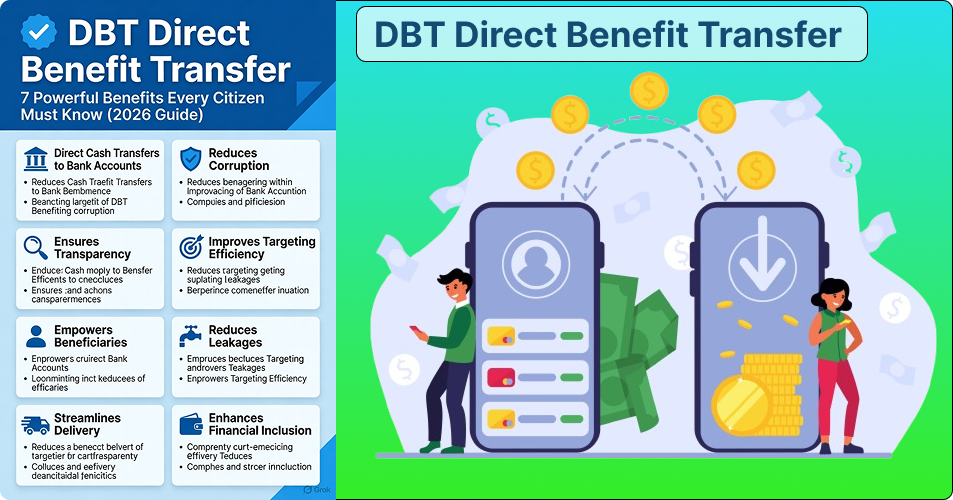
5. 7 Powerful Benefits of DBT (Direct Benefit Transfer)
1. Transparency
D.B.T (Direct Benefit Transfer) ensures that every transaction is recorded digitally.
2. Reduction in Corruption
By removing intermediaries, D.B.T (Direct Benefit Transfer) reduces fund leakage.
3. Faster Payments
Beneficiaries receive money directly without delay.
4. Better Targeting
Only verified individuals receive benefits.
5. Financial Inclusion
D.B.T (Direct Benefit Transfer) encourages citizens to open bank accounts.
6. Empowerment of Women
Funds are often transferred directly to women’s accounts.
7. Cost Efficiency
Administrative expenses are reduced under D.B.T (Direct Benefit Transfer).
6. Schemes Covered Under DBT (Direct Benefit Transfer)
Many government schemes operate under D.B.T (Direct Benefit Transfer), including:
- LPG Subsidy
- Scholarship Programs
- Old Age Pension
- PM-KISAN Scheme
Internal Link Suggestion:
You can link to your article on “PM Kisan Scheme Explained” within your website.
7. Challenges of DBT (Direct Benefit Transfer)
Despite its advantages, D.B.T (Direct Benefit Transfer) faces some challenges:
- Lack of digital literacy
- Banking access issues in rural areas
- Aadhaar linking errors
- Technical failures
Although D.B.T (Direct Benefit Transfer) is effective, continuous improvements are required.
8. Impact of DBT (Direct Benefit Transfer) on Digital India
D.B.T (Direct Benefit Transfer) has played a key role in strengthening India’s digital payment infrastructure.
It supports initiatives like Digital India and promotes cashless transactions.
Over the years, D.B.T (Direct Benefit Transfer) has transferred billions of rupees directly into beneficiary accounts, reducing systemic inefficiencies.
9. Future of DBT (Direct Benefit Transfer)
The future of D.B.T (Direct Benefit Transfer) looks promising.
With advancements in digital banking, mobile penetration, and AI-based verification systems, D.B.T (Direct Benefit Transfer) is expected to become more secure and faster.
The government is also exploring integration with fintech platforms to enhance monitoring and real-time tracking.
Conclusion
D.B.T (Direct Benefit Transfer) is a revolutionary reform in India’s welfare distribution system.
By eliminating middlemen, increasing transparency, and ensuring direct fund transfers, D.B.T (Direct Benefit Transfer) has significantly improved the efficiency of government schemes.
Although certain challenges remain, D.B.T (Direct Benefit Transfer) continues to evolve and strengthen India’s digital governance framework.
Understanding D.B.T (Direct Benefit Transfer) is essential for every citizen who benefits from government welfare programs.
