Category: Finance

DBT Direct Benefit Transfer

DBT Direct Benefit Transfer: 7 Powerful Benefits Every Citizen Must Know (2026 Guide)

Introduction

DBT (Direct Benefit Transfer) is one of the most important digital reforms introduced by the Government of India to improve the way welfare benefits are distributed. In simple terms, DBT (Direct Benefit Transfer) is a system that allows government subsidies, pensions, scholarships, and other financial assistance to be transferred directly into the bank accounts of beneficiaries. Instead of funds moving through multiple layers of administration, DBT (Direct Benefit Transfer) ensures that money reaches the right person quickly and securely.

Before the introduction of DBT (Direct Benefit Transfer), the traditional system of delivering government benefits faced many challenges. There were delays in payments, lack of transparency, corruption, and sometimes even fake beneficiaries claiming funds. Because the process involved intermediaries, the chances of financial leakage were high. DBT (Direct Benefit Transfer) was designed specifically to eliminate these inefficiencies and create a more accountable and transparent welfare distribution mechanism.

The success of DBT (Direct Benefit Transfer) largely depends on digital infrastructure such as Aadhaar identification, bank account linkage, and electronic payment systems. When a beneficiary’s bank account is linked with Aadhaar and registered under a government scheme, the funds are credited directly without any middlemen. This not only reduces corruption but also empowers citizens by giving them direct control over their financial benefits. DBT (Direct Benefit Transfer) has also encouraged millions of people to open bank accounts, contributing to financial inclusion across rural and urban areas.

Over the years, DBT (Direct Benefit Transfer) has expanded to cover numerous government schemes including LPG subsidies, pension programs, and agricultural support schemes. The system has transferred billions of rupees directly into beneficiaries’ accounts, making it one of the largest direct cash transfer systems in the world. While there are still some operational challenges such as digital literacy gaps and technical errors, DBT (Direct Benefit Transfer) continues to evolve and improve.

In today’s rapidly digitalizing economy, understanding DBT (Direct Benefit Transfer) is essential for every citizen. Whether you are a student receiving a scholarship, a farmer benefiting from subsidy programs, or a pensioner depending on government assistance, DBT (Direct Benefit Transfer) plays a crucial role in ensuring that financial support reaches you efficiently and transparently.

1. What Is DBT (Direct Benefit Transfer)?

DBT (Direct Benefit Transfer) is a government payment mechanism through which subsidies, pensions, scholarships, and welfare benefits are transferred directly into the beneficiary’s bank account.

The core idea behind DBT (Direct Benefit Transfer) is simple: eliminate intermediaries and reduce corruption.

Instead of distributing cash physically or through local offices, D.B.T (Direct Benefit Transfer) ensures that funds are deposited electronically into verified bank accounts linked with Aadhaar.

This system increases accountability and improves public trust in government programs.


2. History of DBT (Direct Benefit Transfer)

D.B.T (Direct Benefit Transfer) was officially launched on January 1, 2013, by the Government of India.

It was initially implemented in selected districts and gradually expanded nationwide. The introduction of Aadhaar identification and financial inclusion programs like Jan Dhan Yojana made D.B.T (Direct Benefit Transfer) more effective.

For official updates and statistics, you can refer to the Government of India portal:
https://dbtbharat.gov.in


3. Objectives of DBT (Direct Benefit Transfer)

The main objectives of DBT (Direct Benefit Transfer) include:

  • Reducing corruption
  • Preventing duplicate beneficiaries
  • Ensuring faster fund transfer
  • Increasing transparency
  • Strengthening digital governance

D.B.T (Direct Benefit Transfer) aims to make welfare delivery efficient and accountable.


4. How DBT (Direct Benefit Transfer) Works

The working process of D.B.T (Direct Benefit Transfer) involves several steps:

Step 1: Beneficiary Identification

The applicant registers for a government scheme.

Step 2: Aadhaar and Bank Linking

The beneficiary’s bank account must be linked to Aadhaar.

Step 3: Digital Fund Transfer

After verification, the government transfers money directly into the bank account through D.B.T (Direct Benefit Transfer).

There is no manual handling of funds, which significantly reduces misuse.


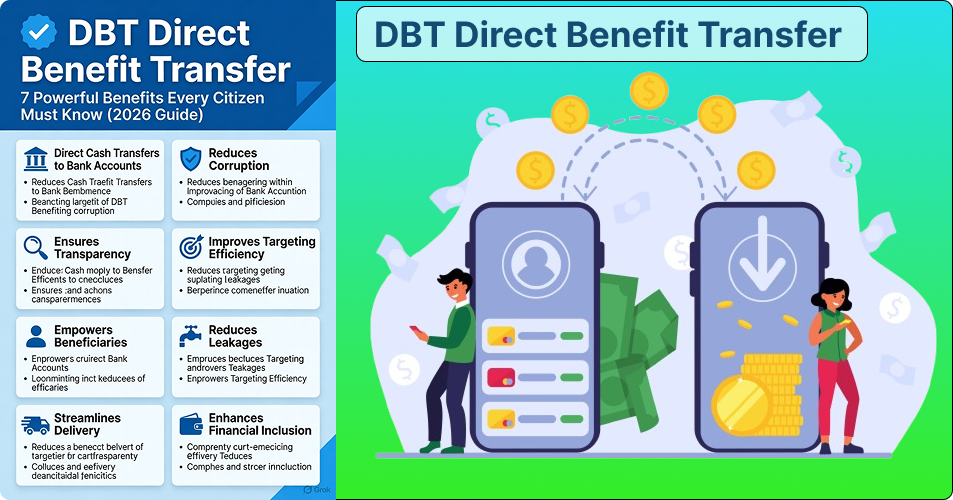
5. 7 Powerful Benefits of DBT (Direct Benefit Transfer)

1. Transparency

D.B.T (Direct Benefit Transfer) ensures that every transaction is recorded digitally.

2. Reduction in Corruption

By removing intermediaries, D.B.T (Direct Benefit Transfer) reduces fund leakage.

3. Faster Payments

Beneficiaries receive money directly without delay.

4. Better Targeting

Only verified individuals receive benefits.

5. Financial Inclusion

D.B.T (Direct Benefit Transfer) encourages citizens to open bank accounts.

6. Empowerment of Women

Funds are often transferred directly to women’s accounts.

7. Cost Efficiency

Administrative expenses are reduced under D.B.T (Direct Benefit Transfer).


6. Schemes Covered Under DBT (Direct Benefit Transfer)

Many government schemes operate under D.B.T (Direct Benefit Transfer), including:

  • LPG Subsidy
  • Scholarship Programs
  • Old Age Pension
  • PM-KISAN Scheme

Internal Link Suggestion:
You can link to your article on “PM Kisan Scheme Explained” within your website.


7. Challenges of DBT (Direct Benefit Transfer)

Despite its advantages, D.B.T (Direct Benefit Transfer) faces some challenges:

  • Lack of digital literacy
  • Banking access issues in rural areas
  • Aadhaar linking errors
  • Technical failures

Although D.B.T (Direct Benefit Transfer) is effective, continuous improvements are required.


8. Impact of DBT (Direct Benefit Transfer) on Digital India

D.B.T (Direct Benefit Transfer) has played a key role in strengthening India’s digital payment infrastructure.

It supports initiatives like Digital India and promotes cashless transactions.

Over the years, D.B.T (Direct Benefit Transfer) has transferred billions of rupees directly into beneficiary accounts, reducing systemic inefficiencies.


9. Future of DBT (Direct Benefit Transfer)

The future of D.B.T (Direct Benefit Transfer) looks promising.

With advancements in digital banking, mobile penetration, and AI-based verification systems, D.B.T (Direct Benefit Transfer) is expected to become more secure and faster.

The government is also exploring integration with fintech platforms to enhance monitoring and real-time tracking.


Conclusion

D.B.T (Direct Benefit Transfer) is a revolutionary reform in India’s welfare distribution system.

By eliminating middlemen, increasing transparency, and ensuring direct fund transfers, D.B.T (Direct Benefit Transfer) has significantly improved the efficiency of government schemes.

Although certain challenges remain, D.B.T (Direct Benefit Transfer) continues to evolve and strengthen India’s digital governance framework.

Understanding D.B.T (Direct Benefit Transfer) is essential for every citizen who benefits from government welfare programs.

Income Tax Return (ITR) कैसे भरें

Income Tax Return (ITR) कैसे भरें – 9 Powerful Steps for an Easy & Stress-Free Filing Guide 2026

Introduction

Income Tax Return (ITR) कैसे भरें is one of the most searched questions every financial year. Many salaried employees, freelancers, and small business owners feel confused about the filing process. Honestly, the procedure looks complicated at first, but once you understand the steps, it becomes much easier.

If you are earning income in India, knowing Income Tax Return (ITR) कैसे भरें is very important. Filing your return correctly helps you avoid penalties, claim refunds, and maintain proper financial records.

In this complete guide, you will learn Income Tax Return (ITR) कैसे भरें step by step, which documents are required, how to select the correct ITR form, and what mistakes you should avoid.

Let’s start from the basics.


Table of Contents

  1. What is Income Tax Return (ITR)?
  2. Who Should File ITR?
  3. Documents Required to File ITR
  4. Choosing the Correct ITR Form
  5. Registration on the Income Tax Portal
  6. Income Tax Return (ITR) कैसे भरें – 9 Powerful Steps
  7. Understanding Tax Calculation
  8. Common Mistakes to Avoid
  9. Benefits of Filing ITR
  10. Final Thoughts

1. What is Income Tax Return (ITR)?

An Income Tax Return (ITR) is a financial statement submitted to the government that shows your total income, deductions, and taxes paid during a financial year.

In India, ITR filing is managed by the
🔗 Income Tax Department of India

The official portal for filing is:
https://www.incometax.gov.in

When you understand Income Tax Return (ITR) कैसे भरें, you are basically learning how to declare your income properly to the government.


2. Who Should File Income Tax Return?

Before learning Income Tax Return (ITR) कैसे भरें, you must know whether you are required to file it.

You should file ITR if:

  • Your annual income exceeds the basic exemption limit
  • You run a business or freelance
  • You earn capital gains from shares or property
  • You want to claim a tax refund
  • You have foreign income or assets

Even if your income is below the limit, filing ITR is beneficial. It builds your financial credibility.


3. Documents Required for Income Tax Return (ITR) कैसे भरें

To understand Income Tax Return (ITR) कैसे भरें smoothly, keep these documents ready:

  • PAN Card
  • Aadhaar Card
  • Form 16 (for salaried individuals)
  • Bank statements
  • Investment proofs (PPF, LIC, ELSS etc.)
  • Home loan interest certificate (if applicable)
  • TDS certificates

Having these documents ready makes Income Tax Return (ITR) कैसे भरें much easier and less stressful.


4. Choosing the Correct ITR Form

Selecting the right form is a crucial step in Income Tax Return (ITR) कैसे भरें.

Here are common ITR forms:

  • ITR-1 (Sahaj) – For salaried individuals with income up to ₹50 lakh
  • ITR-2 – For individuals with capital gains
  • ITR-3 – For business or professional income
  • ITR-4 – For presumptive income scheme

Choosing the wrong form may lead to rejection or notice. So this step should not be ignored.


5. Registration on the Income Tax Portal

To begin Income Tax Return (ITR) कैसे भरें, you must register on the official website of the
Income Tax Department of India

Steps to register:

  1. Visit the portal
  2. Click on Register
  3. Enter PAN details
  4. Verify mobile and email
  5. Create password

After registration, you can start the filing process.


6. Income Tax Return (ITR) कैसे भरें – 9 Powerful Steps

Now let’s understand Income Tax Return (ITR) कैसे भरें in a simple step-by-step manner.


Step 1: Login to the Portal

Enter your PAN number and password on the income tax portal.


Step 2: Select Assessment Year

Choose the relevant assessment year carefully. Many people mistakenly select the wrong year.


Step 3: Choose Filing Type

Select “Original Return” if filing for the first time.


Step 4: Select Appropriate ITR Form

Pick the form based on your income type.


Step 5: Verify Personal Information

Check your name, address, Aadhaar number, and bank details.


Step 6: Enter Income Details

Fill in salary income, business income, house property income, and other sources like interest.

Be careful while entering numbers. Small typing errors sometimes create unnecessary issues.


Step 7: Claim Deductions

Add deductions under:

  • Section 80C
  • Section 80D
  • Section 80G
  • Home loan interest

These reduce your taxable income.


Step 8: Calculate Tax

The portal automatically calculates your tax liability.

If excess tax is paid, you will get a refund.


Step 9: Submit and e-Verify

After reviewing everything, submit the return.

Complete e-verification through:

  • Aadhaar OTP
  • Net Banking
  • Demat account
  • Bank ATM (in some cases)

This is how Income Tax Return (ITR) कैसे भरें properly.

Without verification, your filing is incomplete.

7. Understanding Tax Calculation

To understand Income Tax Return (ITR) कैसे भरें fully, you must know about tax regimes.

India offers two regimes:

Old Tax Regime

Allows multiple deductions and exemptions.

New Tax Regime

Lower tax rates but limited deductions.

You can compare both before filing.

If confused, consult a tax advisor. It is better to double-check rather than regret later.


8. Common Mistakes to Avoid

While learning Income Tax Return (ITR) कैसे भरें, avoid these common mistakes:

  • Entering wrong PAN
  • Selecting incorrect ITR form
  • Not reporting all income
  • Forgetting to e-verify
  • Ignoring Form 26AS

Even a small mistake can delay your refund.


9. Benefits of Filing Income Tax Return

Filing ITR offers several benefits:

✔ Loan Approval

Banks ask for ITR as income proof.

✔ Visa Processing

Many embassies require last 2–3 years ITR.

✔ Claim Refund

If excess tax is deducted, refund is credited.

✔ Avoid Penalty

Late filing attracts penalty.

Regular filing builds financial discipline. And honestly, once you do it once, the fear reduces a lot.


Final Thoughts

Now you clearly understand Income Tax Return (ITR) कैसे भरें step by step. The process may look technical in the beginning, but it becomes manageable with proper preparation.

Keep documents ready.
Choose the correct form.
Verify before submitting.

Life Insurance and Health Insurance difference

Life Insurance and Health Insurance Difference – Complete 2026 Guide

Life Insurance and Health Insurance difference is one of the most searched financial topics today. Many people confuse these two types of insurance, thinking they serve the same purpose. But in reality, they are completely different financial tools designed to protect you in different situations.

If you want to secure your family’s future and also protect yourself from rising medical expenses, understanding the Life Insurance and Health Insurance difference is very important. In this detailed 2026 guide, we will break down everything in simple language.

Let’s start from the basics.


Table of Contents

  1. What is Life Insurance?
  2. What is Health Insurance?
  3. Why Understanding Life Insurance and Health Insurance Difference Matters
  4. 9 Major Differences Explained
  5. Types of Life Insurance
  6. Types of Health Insurance
  7. Premium Comparison
  8. Claim Process Comparison
  9. Tax Benefits
  10. Which One Should You Choose?
  11. Can You Have Both?
  12. Common Mistakes People Make
  13. FAQs
  14. Conclusion

What is Life Insurance?

Life Insurance is a contract between you and an insurance company. You pay a fixed premium, and in return, the insurer promises to pay a lump sum amount to your nominee in case of your death.

The main purpose of life insurance is financial protection for your family. If the earning member of a family dies unexpectedly, life insurance ensures that the family does not suffer financially.

Life insurance is about income replacement and long-term security.


What is Health Insurance?

Health Insurance is a policy that covers your medical expenses. If you fall sick, meet with an accident, or require hospitalization, the insurance company pays the hospital bills as per policy terms.

With medical costs increasing every year, health insurance has become a necessity rather than a luxury.

Health insurance protects you from financial burden during medical emergencies.


Why Understanding Life Insurance and Health Insurance Difference Matters

Understanding the Life Insurance and Health Insurance difference helps you:

  • Make better financial decisions
  • Avoid buying the wrong policy
  • Plan your long-term security
  • Protect both income and health

Many people think buying one insurance is enough. That is not correct. These two serve different purposes.


9 Major Life Insurance and Health Insurance Difference Explained

Below is a detailed comparison.

1. Purpose

  • Life Insurance: Provides financial support to family after death.
  • Health Insurance: Covers hospital and medical expenses while you are alive.

This is the biggest Life Insurance and Health Insurance difference.


2. Benefit Receiver

  • Life Insurance: Nominee receives money.
  • Health Insurance: Policyholder receives treatment benefits.

3. Type of Payment

  • Life Insurance: Lump sum amount.
  • Health Insurance: Pays hospital bills as per coverage.

4. Duration

  • Life Insurance: Long-term (10–30 years or whole life).
  • Health Insurance: Usually 1 year, renewable annually.

5. Risk Covered

  • Life Insurance: Death risk.
  • Health Insurance: Illness, surgery, accident, hospitalization.

6. Investment Component

  • Some life insurance policies include savings/investment.
  • Health insurance has no investment benefit.

7. Premium Amount

  • Life Insurance premium depends on coverage and age.
  • Health Insurance premium depends on age, health condition, and coverage amount.

8. Claim Frequency

  • Life Insurance claim happens once.
  • Health Insurance claims can happen multiple times.

9. Tax Benefits

  • Life Insurance: Section 80C.
  • Health Insurance: Section 80D.

Understanding these differences clearly explains the Life Insurance and Health Insurance difference.


Types of Life Insurance

Life insurance comes in different forms:

✔ Term Insurance

Pure protection plan with no maturity benefit.

✔ Whole Life Insurance

Covers you for entire lifetime.

✔ Endowment Plan

Combination of insurance + savings.

✔ ULIP

Insurance + market-linked investment.

Each type serves a different financial goal.


Types of Health Insurance

Health insurance also has various categories:

✔ Individual Health Plan

Covers single person.

✔ Family Floater Plan

Covers entire family under one policy.

✔ Senior Citizen Plan

Designed for elderly people.

✔ Critical Illness Plan

Covers serious diseases like cancer, heart attack.

Knowing types helps better understand Life Insurance and Health Insurance difference.


Premium Comparison

Life insurance premiums are usually cheaper for high coverage if bought early. For example, a young 30-year-old can get ₹1 crore term insurance at a low annual premium.

Health insurance premiums increase with age because health risks increase.

So if you delay health insurance, it becomes expensive.


Claim Process Comparison

Life Insurance Claim Process

  1. Inform insurance company.
  2. Submit death certificate.
  3. Submit policy documents.
  4. Verification process.
  5. Lump sum payment to nominee.

Health Insurance Claim Process

  1. Inform insurer before hospitalization (cashless).
  2. Submit hospital bills.
  3. Approval process.
  4. Payment to hospital or reimbursement.

The claim method clearly shows the Life Insurance and Health Insurance difference.


Tax Benefits

Both policies offer tax benefits.

Life Insurance

  • Deduction under Section 80C.
  • Maturity proceeds may be tax-free (as per conditions).

Health Insurance

  • Deduction under Section 80D.
  • Extra deduction for senior citizens.

This makes both policies financially attractive.


Which One Should You Choose?

The answer is simple: Both.

If you are the sole earning member, life insurance is mandatory.

If you want to avoid hospital bills destroying your savings, health insurance is mandatory.

Life Insurance and Health Insurance difference shows that they protect different risks.


Can You Have Both?

Yes, and you should.

Financial experts recommend:

  • Term insurance for income protection.
  • Health insurance for medical emergencies.

Combining both gives complete protection.


Common Mistakes People Make

  • Buying investment-heavy life insurance without understanding terms.
  • Ignoring health insurance at young age.
  • Not reading policy exclusions.
  • Delaying insurance purchase.

Insurance planning requires careful thinking.


Frequently Asked Questions

Q1. What is the main Life Insurance and Health Insurance difference?

Life insurance pays after death, health insurance pays medical bills.

Q2. Is health insurance more important than life insurance?

Both are important for different reasons.

Q3. Can I buy both policies?

Yes, and it is recommended.

Q4. Which insurance is cheaper?

Term life insurance is usually cheaper for high coverage.


Final Conclusion

Understanding the Life Insurance and Health Insurance difference is essential for smart financial planning. Life insurance protects your family’s future income, while health insurance protects your savings from medical emergencies.

In 2026, rising medical costs and uncertain life risks make both insurances extremely important. Do not treat insurance as an expense. It is financial protection.

Choose wisely, read policy terms carefully, and invest according to your needs. A small premium today can prevent a huge financial crisis tomorrow.

Stock Market क्या है?

Stock Market क्या है? What is Stock Market in India Powerful Beginner’s Guide to Smart Investing 2026

Introduction: Stock Market आखिर होता क्या है?

The stock market is a financial marketplace where shares of companies are bought and sold. When a company wants to raise money for business expansion, it offers its shares to the public. People who buy these shares become partial owners of the company and are called shareholders.Stock Market क्या है?

In India, the two major stock exchanges are the BSE (Bombay Stock Exchange) and the NSE (National Stock Exchange). All buying and selling of listed company shares takes place through these exchanges. The price of shares changes regularly based on demand and supply in the market.

The stock market is not just a place for trading; it also reflects the overall health of a country’s economy. When the market rises, it often indicates economic growth and investor confidence. When it falls, it may signal economic uncertainty or slowdown.Stock Market क्या है?

For long-term investors, the stock market can be a powerful tool for wealth creation. However, it also involves risk, so proper knowledge, research, and patience are essential before investing.


Stock Market क्या है? (What is Stock Market?)

Stock Market ek aisa market hota hai jahan companies apne shares (hisse) bechti hain aur investors un shares ko kharidte–bechte hain.

Simple words me:

  • Company = Business
  • Share = Company ka ek chhota hissa
  • Investor = Jo us hissa ko kharidta hai

Jab aap kisi company ka share kharidte hain, to aap us company ke chhote malik (owner) ban jaate hain.

Example:

Maan lijiye ek company ke 100 shares hain.
Agar aap 10 shares kharid lete hain, to aap us company ke 10% owner ho jaate hain.


Share kya hota hai?

Share ka matlab hota hai ownership ka hissa.

  • Company jab paise raise karna chahti hai, to wo apne shares public ko sell karti hai
  • Jo log shares kharidte hain, wo shareholder ban jaate hain

Share ke badle investor ko do tarah ka fayda mil sakta hai:
Capital Gain (share price badhne par)
Dividend (company ke profit me se hissa)


Stock Market ka main purpose kya hai?

Stock Market ke do main purposes hote hain:

Companies ke liye:

  • Business expand karne ke liye paisa milta hai
  • Loan lene ke bina capital raise hota hai

Investors ke liye:

  • Paise ko grow karne ka moka
  • Long-term wealth creation
  • Passive income (dividend ke through)

India ke major Stock Exchanges kaun se hain?

India me mainly do bade stock exchanges hain:

1. BSE (Bombay Stock Exchange)

  • Asia ka sabse purana stock exchange
  • Sensex yahin se aata hai

2. NSE (National Stock Exchange)

  • India ka sabse popular exchange
  • Nifty 50 yahin ka index hai

Aaj ke time me almost sabhi trading online hoti hai.


Stock Market me kaun-kaun participate karta hai?

Stock Market sirf traders ke liye nahi hota. Yahan kai tarah ke log hote hain:

  • Retail Investors (aam log)
  • Mutual Funds
  • Banks & Financial Institutions
  • Foreign Investors (FII / FPI)
  • Traders (Intraday / Swing)

Stock Market kaise kaam karta hai? (How Stock Market Works)

Stock Market demand & supply ke principle par kaam karta hai.

Simple process:

Company list hoti hai stock exchange par
Investors buy & sell order lagate hain
Price demand aur supply ke hisaab se upar-neeche hoti hai
Exchange transaction ko complete karta hai

Sab kuch SEBI (Securities and Exchange Board of India) ke rules ke under hota hai.


SEBI kya hai?

SEBI India ka stock market regulator hai.

SEBI ka kaam:

  • Investors ko protect karna
  • Fraud aur scam ko rokna
  • Fair trading ensure karna
  • Companies aur brokers ko regulate karna

Matlab Stock Market koi illegal cheez nahi hai — yeh government regulated system hai.


Stock Market me invest karne ke types

Long-Term Investment

  • 5–10 saal ya usse zyada ke liye
  • Strong companies me investment
  • Kam risk, stable return

Short-Term Investment

  • Kuch mahine se 1–2 saal
  • Moderate risk

Trading

  • Daily ya weekly buying–selling
  • High risk, high reward
  • Beginners ke liye recommended nahi

Stock Market aur Gambling me difference

Bahut log kehte hain:Stock Market क्या है?
“Stock Market gambling hai”

Reality:

Stock MarketGambling
Research basedLuck based
RegulatedIllegal
Long-term wealthLoss chances high
Skill + patiencePure chance

Agar aap knowledge + discipline ke saath invest karte hain, to Stock Market gambling nahi hai.


Stock Market se paise kaise bante hain?

Share Price Increase

Agar aapne ₹100 ka share kharida aur wo ₹200 ho gaya — profit!

Dividend Income

Company profit kamati hai aur investors ko dividend deti hai.

Compounding Power

Long-term me reinvestment se paisa exponentially grow hota hai.


Beginners ke liye Stock Market safe hai?

Haan, agar:Stock Market क्या है?

  • Aap long-term sochte hain
  • Sirf paise ka risk lete hain jo loss ho sake
  • Research karke invest karte hain

Nahi, agar:

  • Jaldi ameer banna chahte hain
  • Tips ke bharose trade karte hain
  • Loan le kar invest karte hain

Stock Market start karne ke liye kya chahiye?

Basic requirements:

  • PAN Card
  • Aadhaar Card
  • Bank Account
  • Demat Account
  • Trading Account

Aaj kal online 10–15 minute me account open ho jata hai.


Stock Market me beginners ko kya avoid karna chahiye?

Overtrading
Fake tips
Emotional buying & selling
Penny stocks without knowledge
One stock me sara paisa lagana


Stock Market ke fayde

Wealth creation
Inflation se protection
Passive income
Financial freedom
Ownership in big companies


Stock Market ke risks

Market volatility
Company failure
Emotional decisions
Lack of knowledge

Risk ko kam kiya ja sakta hai:

  • Diversification se
  • Long-term investment se
  • Continuous learning se

Stock Market ke Important Terms (Beginners ke liye)

Agar aap Stock Market me naya ho, to kuch basic terms samajhna bahut zaroori hai.

1. Bull Market

Jab market lagatar upar ja rahi hoti hai aur shares ke price badh rahe hote hain, use Bull Market kehte hain.

Bull Market = Positive market sentiment

2. Bear Market

Jab market lagatar gir rahi hoti hai aur log panic selling karte hain, use Bear Market kaha jata hai.

Bear Market = Negative market sentiment


3. IPO (Initial Public Offering)

Jab koi company pehli baar stock market me aati hai, aur apne shares public ko offer karti hai, use IPO kehte hain.

IPO ka fayda:

  • Early investment ka chance
  • Strong company ho to long-term me achha return

Lekin har IPO profit nahi deta, isliye research zaroori hai.


4. Market Index (Sensex & Nifty)

Index market ki overall performance batata hai.

  • Sensex → BSE ke top 30 companies
  • Nifty 50 → NSE ke top 50 companies

Agar Sensex/Nifty upar ja raha hai, matlab overall market strong hai.Stock Market क्या है?


Mutual Funds aur Stock Market ka relation

Bahut se beginners direct stocks lene se darte hain. Unke liye Mutual Funds best option hote hain.

Mutual Fund kya hai?

Mutual Fund ek aisa fund hota hai jahan:

  • Kai investors ka paisa collect hota hai
  • Professional fund manager invest karta hai
  • Risk diversified hota hai

Mutual Funds indirectly Stock Market me hi invest karte hain.Stock Market क्या है?

Beginners ke liye best option:

  • Index Funds
  • Large Cap Funds
  • SIP (Systematic Investment Plan)

SIP kya hota hai? (Systematic Investment Plan)

SIP ka matlab hai har month thoda-thoda paisa invest karna.

Example:

  • ₹1,000 per month
  • 15–20 saal
  • Power of compounding se bada fund ban sakta hai

SIP ka fayda:
Market timing ka stress nahi
Discipline banta hai
Long-term wealth creation


Stock Market me loss kyun hota hai?

Bahut log Stock Market se loss karke nikal jaate hain, reason market nahi hoti — mistakes hoti hain.

Common mistakes:

Bina knowledge ke invest karna
WhatsApp / Telegram tips par bharosa
Jaldi profit ka lalach
Market girte hi panic sell
Risk management ignore karna

Agar aap in galtiyon se bach gaye, to loss ke chances kaafi kam ho jaate hain.


Stock Market learning kaise start karein?

Agar aap beginner ho, to learning ka simple roadmap follow karo:

Step 1:

  • Basic concepts samjho (jaise aap abhi padh rahe ho)

Step 2:

  • Free resources use karo
    • Blogs
    • YouTube (trusted channels only)

Step 3:

  • Paper trading / virtual trading karo

Step 4:

  • Small amount se start karo
    • ₹500 – ₹1000 se bhi possible hai

Kya Stock Market sabke liye hai?

Honest answer Haan, lekin condition ke saath

Stock Market un logon ke liye best hai jo:
Patience rakhte hain
Emotion control kar sakte hain
Long-term sochte hain

Stock Market unke liye nahi hai jo:
Overnight rich banna chahte hain
Risk bilkul nahi lena chahte
Daily profit expect karte hain Stock Market क्या है?


Stock Market aur Long-Term Wealth Creation

India ke kai successful investors ne yeh prove kiya hai ki:

“Stock Market short term me voting machine hai,
long term me weighing machine.”

Long-term investment ka magic:

  • Time + Compounding
  • Quality companies
  • Regular investment

Is combination se financial freedom achieve ki ja sakti hai.Stock Market क्या है?


Frequently Asked Questions (FAQs)

Stock Market me minimum kitna paisa chahiye?

Aap ₹500–₹1000 se bhi start kar sakte ho.

Kya Stock Market safe hai?

Haan, agar aap long-term aur disciplined approach follow karte ho.

Beginners ke liye best option kya hai?

Index Funds ya Blue-chip stocks.

Kya loss hona sure hai?

Nahi, lekin bina knowledge ke risk zaroor hota hai.


Conclusion: Kya aapko Stock Market me invest karna chahiye?

Agar aap:
Financially independent banna chahte hain
Long-term soch rakhte hain
Thoda time seekhne ko ready hain

To Stock Market aapke liye best option ho sakta hai. Stock Market क्या है?

Stock Market Kaise Start Karein

Stock Market Kaise Start Karein? Complete information 2026

Introduction

Aaj ke digital zamane mein Stock Market sirf bade investors ya finance experts tak simit nahi raha. Ab koi bhi aam insaan, chahe student ho, job karne wala ho ya business owner, aasani se stock market mein invest kar sakta hai. Lekin sabse bada sawal hota hai – “Stock Market kaise start karein?”

Stock Market ek aisi jagah hai jahan companies apne shares bechti hain aur investors un shares ko kharid kar company ka chhota sa hissa ban jaate hain. Jab company grow karti hai, to share ki value badhti hai aur investor ko profit milta hai. Isi tarah agar company ka performance kamzor ho, to nuksaan bhi ho sakta hai. Isliye stock market mein entry lene se pehle basic knowledge aur sahi strategy hona bahut zaroori hai.

India mein stock market mainly do exchanges par kaam karta hai – BSE (Bombay Stock Exchange) aur NSE (National Stock Exchange). Aaj kal online trading apps aur Demat account ki madad se ghar baithe hi shares kharide aur beche ja sakte hain. Lekin bina samajh ke investment karna risky ho sakta hai.

Is guide mein hum simple aur step-by-step tareeke se samjhenge:

  • Stock Market kya hota hai
  • Investment start karne ke liye kya-kya zaroori hai
  • Demat aur Trading account kaise kholen
  • Pehla share kaise khariden
  • Beginners ke liye important tips

Agar aap bhi apni earning ko grow karna chahte hain aur long-term wealth banana chahte hain, to stock market ek powerful option ho sakta hai — bas sahi knowledge aur patience ke saath shuruaat karni hogi.

Aage ke sections mein hum detail mein dekhenge ki ek beginner ko stock market mein entry lene se pehle kya-kya steps follow karne chahiye.


Step 1: Apni Mindset Clear Karein (Most Important)

Stock Market me entry lene se pehle mindset clear hona bahut zaroori hai.

Beginners ko ye samajhna hoga:

Stock Market = Long-term game
Stock Market ≠ Jaldi ameer banne ka shortcut

Agar aap:

  • Patience rakh sakte ho
  • Learning ke liye ready ho
  • Loss ko handle kar sakte ho

Tabhi Stock Market start karein.


Step 2: Basic Knowledge Seekhein (Zero to One)

Direct paise lagane se pehle basic concepts samajhna zaroori hai.

Aapko ye cheezein aani chahiye:

  • Share kya hota hai
  • Stock Market kaise kaam karta hai
  • Profit & loss kaise hota hai
  • Risk kya hota hai

Tip:
Free resources se start karein:

  • Trusted finance blogs
  • Beginner-friendly YouTube videos
  • SEBI awareness content

Pehle seekho, phir invest karo.


Step 3: Demat Account & Trading Account Open Karein

Stock Market me invest karne ke liye Demat aur Trading Account zaroori hota hai.

Demat Account

  • Shares ko digitally store karta hai
  • Jaise bank me paisa hota hai, waise Demat me shares

Trading Account

  • Shares buy & sell karne ke kaam aata hai

Required Documents:

  • PAN Card
  • Aadhaar Card
  • Bank Account
  • Mobile number (linked with Aadhaar)

Aaj kal online 10–15 minutes me account open ho jata hai.


Step 4: Bank Account Ko Trading Account Se Link Karein

Trading ke liye:

  • Paisa bank se trading account me jaata hai
  • Profit wapas bank account me aata hai

Isliye bank linking mandatory hoti hai.

Tip:
Hamesha personal savings account ka hi use karein.


Step 5: Pehle Mutual Funds ya Index Funds Se Start Karein

Agar aap bilkul beginner ho, to direct stocks se start karna risky ho sakta hai.

Best option for beginners:

Index Funds
Mutual Funds
SIP (Systematic Investment Plan)

SIP ka fayda:

  • Small amount se start
  • Risk kam
  • Market timing ka tension nahi

Example:

  • ₹1000 per month
  • Long-term (10–20 years)
  • Compounding se bada fund

Step 6: Small Amount Se Direct Stocks Me Entry

Jab basic knowledge aa jaaye, tab aap direct stocks me entry le sakte ho.

Beginners ke liye best stocks:

  • Large-cap companies
  • Blue-chip stocks
  • Strong fundamentals wali companies

Penny stocks se door raho
Tips ke bharose invest mat karo

Rule:
“Sirf utna paisa lagao jo loss hone par life disturb na kare.”


Step 7: Research Karna Seekhein (Fundamental + Basic Technical)

Fundamental Analysis

Company ke basics check karo:

  • Business model
  • Profit growth
  • Debt level
  • Management quality

Basic Technical Analysis

  • Support & resistance
  • Trend samajhna
  • Entry timing

Beginners ke liye fundamental analysis zyada important hota hai.


Step 8: Long-Term Strategy Banao

Successful investors hamesha plan ke saath invest karte hain.

Apni strategy clear rakho:

  • Goal kya hai? (retirement, house, education)
  • Kitne saal invest karna hai?
  • Kitna risk le sakte ho?

Without plan = confusion + loss


Step 9: Risk Management Follow Karo

Stock Market me risk hota hai, lekin manage kiya ja sakta hai.

Risk kam karne ke rules:

Ek stock me sara paisa mat lagao
Different sectors me invest karo
Emergency fund alag rakho
Loss me panic sell mat karo

Risk manage karna seekh gaye, to survival easy ho jata hai.


Step 10: Common Beginner Mistakes Avoid Karo

Most log Stock Market se paisa isliye nahi bana paate kyunki wo ye galtiyaan karte hain:

WhatsApp / Telegram tips
Overtrading
Emotional decisions
Loan le kar invest
Daily profit expectation

Yaad rakho:
Market se zyada dangerous hoti hai galat mentality.


Kitne Paise Se Stock Market Start Karein?

Good news Bahut zyada paisa nahi chahiye

  • ₹500 – ₹1000 se SIP start
  • ₹1000 – ₹2000 se stocks buy

Important paisa nahi, discipline aur consistency hai.


Stock Market Me Success Ka Real Formula

Success ka koi shortcut nahi hota.

Real formula:

Knowledge + Patience + Discipline + Time

Jo log is formula ko follow karte hain,
wo dheere-dheere financially strong ban jaate hain.

Step 11: Right Platform / Broker Ka Selection Kaise Karein?

Stock Market start karne me broker ka role bahut important hota hai.
Broker hi wo medium hota hai jiske through aap shares buy–sell karte ho.

Beginner ke liye broker choose karte waqt dhyan dein:

Easy mobile app
Low brokerage charges
Good customer support
Learning resources available ho

Tip:
Sabse sasta broker hi best ho, aisa zaroori nahi.
User-friendly aur trusted platform choose karna zyada important hai.


Step 12: First Investment Kaise Karein? (Practical Example)

Bahut log account open karne ke baad confuse ho jaate hain:
“Ab pehla investment kaise karein?”

Simple beginner example:

  • Total capital: ₹5,000
  • ₹3,000 → Mutual Fund / Index Fund
  • ₹2,000 → 1–2 strong large-cap stocks

Is tarah:

  • Risk bhi kam rahega
  • Confidence bhi build hoga
  • Learning bhi hogi

Rule:
Pehle survive karna seekho, phir profit apne aap aayega.


Step 13: Portfolio Banana Seekhein (Very Important)

Portfolio ka matlab hota hai aapke saare investments ka collection.

Beginner portfolio kaisa hona chahiye?

4–6 stocks se zyada nahi
Different sectors (IT, Bank, FMCG, Pharma)
Mutual Fund + Stocks ka mix

Sirf ek stock me paisa lagana
Sirf ek sector par depend rehna

Diversification se:

  • Risk kam hota hai
  • Long-term stability milti hai

Step 14: Market Girne Par Kya Karein?

Market girne par beginners sabse zyada galti karte hain.

Jab market gire:

Panic selling mat karo
News dekh kar daro mat
Company fundamentals check karo
Long-term view rakho

Yaad rakho:

“Market girti hai tabhi future ke returns bante hain.”

Agar aap strong companies me invested ho, to temporary fall se ghabrane ki zaroorat nahi.


Step 15: Discipline Aur Patience Kyun Zaroori Hai?

Stock Market me paisa fast decisions se nahi,
right decisions + time se banta hai.

Discipline ka matlab:

Regular investment
Rules follow karna
Emotions control karna

Patience ka matlab:

Results ka wait karna
Short-term noise ignore karna

Jo log patience rakhte hain,
wo hi long-term winners bante hain.


Step 16: Stock Market Se Related Myths (Jo Beginners Ko Rokte Hain)

Myth 1: Bahut zyada paisa chahiye

Truth: ₹500–₹1000 se bhi start possible

Myth 2: Sirf experts kama sakte hain

Truth: Common log bhi kama rahe hain

Myth 3: Market hamesha risky hai

Truth: Risk knowledge se kam hota hai

Myth 4: Daily trading zaroori hai

Truth: Long-term investing best hai


Step 17: Stock Market Aur Job – Kya Dono Saath Ho Sakte Hain?

Haan, bilkul
Actually job ke saath investing best combination hai.

Reason:

  • Regular income milti hai
  • SIP easily chalti hai
  • Long-term goals achieve hote hain

Aapko trader banne ki zaroorat nahi,
smart investor banna kaafi hai.


Step 18: Emotional Control – Success Ka Hidden Secret

Stock Market me 80% game mind ka hota hai.

Emotions jo nuksaan karte hain:

Fear (dar)
Greed (lalach)
Overconfidence

Successful investor:

Plan follow karta hai
Noise ignore karta hai
Long-term focus rakhta hai

Market se jeetne ke liye,
pehle khud par control zaroori hai.


Beginners Ke Liye Golden Rules

Agar aap in rules ko follow kar liya,
to 50% problems waise hi solve ho jaayengi:

Hamesha long-term socho
Small amount se start karo
Learning kabhi band mat karo
Loss ko teacher banao
Consistency rakho


Frequently Asked Questions (FAQs)

Kya Stock Market beginners ke liye safe hai?

Haan, agar aap long-term aur learning mindset ke saath ho.

Kya daily trading zaroori hai?

Nahi, beginners ke liye bilkul nahi.

Loss ho gaya to kya karein?

Panic nahi, analysis karein aur seekhein.

Kitna time dena hota hai?

Hafte me 2–3 ghante kaafi hain (long-term investors ke liye).


Final Conclusion

Stock Market start karna difficult nahi,
difficult hai discipline maintain karna.

Agar aap:
Slowly seekhte ho
Small amount se start karte ho
Long-term sochte ho

To Stock Market aapke liye best wealth creation tool ban sakta hai.

How Share Market Works in India

Share Market कैसे काम करता है?How Share Market Works in India

Introduction

The Share Market plays a vital role in the growth of the Indian economy and has become one of the most popular ways to create long-term wealth. With the rise of online trading platforms, mobile apps, and easy Demat account access, investing in the share market is no longer limited to big investors or financial experts. However, before investing, it is essential to understand how the share market works in India.

In India, the share market operates mainly through two major stock exchanges — the National Stock Exchange (NSE) and the Bombay Stock Exchange (BSE). Companies list their shares on these exchanges to raise capital, and investors buy and sell these shares with the aim of earning profits. Share prices change continuously based on demand and supply, company performance, economic conditions, and market news.

In this article, we will explain How Share Market Works in India in a simple and beginner-friendly way. You will learn about the basic structure of the share market, the role of Demat and trading accounts, and the complete process of buying and selling shares. This guide is ideal for beginners who want to start investing with confidence and clarity.

  • Share Market kaise kaam karta hai
  • Buy–Sell process kya hota hai
  • Price kaise decide hoti hai
  • Kaun-kaun se log involved hote hain

Share Market kya hota hai? (Short Recap)

Share Market ek aisi jagah hai jahan:

  • Companies apne shares (ownership parts) bechti hain
  • Investors un shares ko buy aur sell karte hain

Jab aap share kharidte ho, aap company ke chhote owner ban jaate ho

Step 1: Company Share Market me aati hai (IPO)

Jab koi company ko growth ke liye paisa chahiye hota hai,
wo IPO (Initial Public Offering) ke through Share Market me entry leti hai.

Company public ko shares offer karti hai
Investors un shares ko kharid sakte hain

Step 2: Investors Buy & Sell Order Lagate Hain

IPO ke baad shares Stock Exchange par list ho jaate hain
(India me mainly NSE & BSE).

Investors:

  • Buy order lagate hain (khareedne ke liye)
  • Sell order lagate hain (bechne ke liye)

Ye sab online trading platform ke through hota hai.

Step 3: Demand & Supply Se Price Decide Hoti Hai

Share price ka koi fixed rate nahi hota.

Zyada buyers → Price upar
Zyada sellers → Price neeche

Example:

  • Agar log company ke future ko positive samajhte hain → demand badhegi
  • Agar company me problem aaye → selling badhegi

Isi process se share price move karti hai.How Share Market Works in India

Step 4: Stock Exchange Transaction Complete Karta Hai

Stock Exchange:

  • Buy & sell order match karta hai
  • Transaction ko secure aur transparent banata hai

Is process me SEBI (regulator) nazar rakhta hai taaki fraud na ho.

Share Market me kaun-kaun kaam karta hai?

1. Retail Investors

Aam log jo:

  • Long-term invest karte hain
  • SIP ya direct stocks lete hain

2. Institutional Investors

  • Mutual Funds
  • Banks
  • Insurance companies

Ye log large amount invest karte hain.

3. Foreign Investors (FII/FPI)

Foreign countries ke investors jo Indian market me paisa lagate hain.How Share Market Works in India

4. Traders

Jo:

  • Daily ya short-term buying–selling karte hain
  • Market movement se profit nikalte hain

Beginners ke liye trading risky hoti hai.

Share Market me paisa kaise banta hai?

1. Capital Gain

Agar:

  • Aapne share ₹100 me kharida
  • Aur ₹150 me bech diya

₹50 ka profit = Capital Gain

2. Dividend

Kuch companies apne profit ka hissa
shareholders ko dividend ke roop me deti hain.

3. Long-Term Compounding

Long-term investment me:

  • Profit par phir se profit
  • Time ke saath wealth grow hoti hai

Share Market ka role kya hai Economy me?

Share Market:How Share Market Works in India

  • Companies ko grow karne me help karta hai
  • Employment generate karta hai
  • Investors ko wealth create karne ka chance deta hai

Isliye Share Market economy ka important pillar hai.

Share Market safe hai ya risky?

Dono.How Share Market Works in India

Safe jab:

Aap long-term invest karte ho
Strong companies choose karte ho
Knowledge ke saath decision lete ho

Risky jab:

Tips par depend rehte ho
Overtrading karte ho
Emotion me buy–sell karte ho

Risk market me nahi, approach me hota hai.

Beginners ke liye Share Market kaise easy banayein?

Pehle basic samjho
Mutual Funds / Index Funds se start karo
Small amount invest karo
Patience rakho
Learning continue rakho

Common Myths (Jo galat hain)

Share Market sirf ameer logon ke liye hai
Bina luck ke paisa nahi banta
Daily trading zaroori hai

Truth:
Discipline + Time + Knowledge = Success

Share Market ka Back-End System Kaise Kaam Karta Hai?

Bahut log sirf buy–sell dekhte hain, lekin share market ke peeche ek strong technical system hota hai.

Clearing & Settlement Process

Jab aap koi share buy ya sell karte ho, to transaction turant complete nahi hota.

India me T+1 settlement cycle follow hota hai:

  • T (Trade Day) → Buy/Sell order execute
  • T+1 Day
    • Buyer ke Demat me shares credit
    • Seller ke bank account me paisa credit

Isse system transparent aur secure rehta hai.How Share Market Works in India

Demat Account ka Role Share Market Me

Demat account ke bina aaj ke time me share market possible hi nahi hai.

Demat Account kya karta hai?

  • Physical share certificates ko digital form me rakhta hai
  • Buy kiye gaye shares ko store karta hai
  • Sell hone par shares deduct karta hai

Example:
Jaise bank account me paisa hota hai,
waise hi Demat account me shares hote hain.

Trading Account kaise kaam karta hai?

Trading account wo medium hota hai jahan se:How Share Market Works in India

  • Aap buy order place karte ho
  • Sell order place karte ho

Demat + Trading + Bank Account
Teeno milkar Share Market ko smooth banate hain.

Share Price Ko Affect Karne Wale Major Factors

Share price sirf luck se move nahi karti.
Uske peeche kai logical reasons hote hain.

1. Company Performance

  • Profit badh raha hai ya ghat raha hai
  • Sales growth
  • Future expansion plans

Strong performance = positive price movement

2. News & Events

  • New project launch
  • Government policy
  • Result announcement
  • Merger / Acquisition

Positive news → price up
Negative news → price down

3. Market Sentiment

Kabhi-kabhi market:How Share Market Works in India

  • Fear me girta hai
  • Over-excitement me upar jaata hai

Isliye short-term me price irrational bhi ho sakti hai.

4. Global Market Impact

US market, crude oil prices, interest rates
Indian market ko bhi affect karte hain.

Share Market Me Orders Ke Types

Beginners ke liye orders samajhna bahut zaroori hai.

1. Market Order

  • Turant current price par buy/sell
  • Fast execution

Price control nahi hota

2. Limit Order

  • Aap apni price set karte ho
  • Order tabhi execute hota hai jab price match ho

Beginners ke liye safer option

3. Stop Loss Order

  • Loss limit karne ke liye
  • Automatic sell ho jata hai

Risk management ke liye bahut important

Long-Term Investors vs Traders – Kaun Kaise Kaam Karta Hai?

Long-Term Investors

  • Years tak shares hold karte hain
  • Company fundamentals par focus
  • Kam stress, stable returns

Traders

  • Short-term buying–selling
  • Price movement par focus
  • High risk, high stress

Beginners ke liye:
Investor banna zyada safe hota hai.

Share Market Aur Mutual Funds Ka Connection

Mutual Funds bhi directly Share Market me hi invest karte hain.

Difference sirf itna hai:

  • Aap directly shares nahi lete
  • Fund manager aapki taraf se decision leta hai

Isliye beginners ke liye:
Mutual Funds
Index Funds
best option maane jaate hain.

Share Market Me Risk Kaise Control Hota Hai?

Risk puri tarah khatam nahi hota,
lekin control zaroor ho sakta hai.

Risk control ke tarike:

Diversification (alag-alag stocks)
Long-term holding
Stop loss ka use
Overtrading se bachaav

Yaad rakho:

“Risk lene aur risk manage karne me farak hota hai.”

Share Market Me Beginners Sabse Zyada Galti Kahan Karte Hain?

1. Tips Par Bharosa

WhatsApp / Telegram tips
Sabse bada loss yahin se hota hai.

2. Jaldi Profit Ki Expectation

Share Market patience ka game hai, speed ka nahi.

3. Panic Selling

Market girte hi shares bech dena.

4. Bina Plan Invest Karna

Goal ke bina investment = confusion.

Share Market Me Successful Log Kya Alag Karte Hain?

Successful investors:
Emotion control karte hain
News kam, numbers zyada dekhte hain
Long-term vision rakhte hain
Discipline follow karte hain

Unke liye share market business ownership jaisa hota hai, gambling jaisa nahi.

Share Market Aur Indian Economy

Share Market sirf investors ke liye nahi,
poori economy ke liye important hota hai.

Economy ko fayde:

  • Companies ko capital milta hai
  • Jobs create hoti hain
  • Foreign investment aata hai
  • Growth accelerate hoti hai

Isliye government aur SEBI market ko tightly regulate karte hain.

Share Market Me Aaj Kaam Karna Pehle Se Aasan Kyun Hai?

Pehle:

  • Physical shares
  • Zyada paperwork
  • Limited access

Aaj:
Online Demat
Mobile trading apps
Low brokerage
Free learning resources

Isliye aaj common aadmi bhi market ka hissa ban sakta hai.

Beginners Ke Liye Share Market Ko Samajhne Ka Simple Formula

Agar ek line me samajhna ho to:

Company → Performance → Demand/Supply → Share Price

Jitna achha business,
utna zyada long-term return ka chance.

Frequently Asked Questions (FAQs)

Share Market aur Stock Market me difference?

Koi difference nahi, dono almost same hi hote hain.

Minimum kitna paisa chahiye?

₹500–₹1000 se bhi start possible hai.

Kya loss hona pakka hai?

Nahi, agar long-term aur smart investing karo.

Share Market daily upar-neeche kyun hota hai?

Demand–supply, news aur sentiment ki wajah se.

Kya Share Market me loss avoid ho sakta hai?

Completely nahi, lekin knowledge se kaafi had tak.

Beginners ke liye safest approach kya hai?

Mutual Funds + Long-term investing.

Final Conclusion

Share Market ek systematic, regulated aur logical platform hai.
Ye koi lottery nahi, balki knowledge-based wealth creation tool hai.

Agar aap:

  • Samajh kar invest karte ho
  • Jaldi ameer banne ka sapna chhod dete ho
  • Long-term sochte ho

To Share Market aapke liye game changer ban sakta hai.

Mutual Fund कैसे काम करता है?

Mutual Fund कैसे काम करता है? – Complete Step-by-Step Guide for 2026

1. Introduction

Mutual Fund कैसे काम करता है—this is one of the most important questions for investors who want to move beyond basic knowledge and understand the real mechanism behind mutual fund returns. Many people invest in mutual funds through SIPs or lump sum investments, but very few actually understand what happens to their money after investing.

A mutual fund works on a simple concept of pooling money from multiple investors and investing it across various financial instruments. This pooled money is managed by professional fund managers who make investment decisions based on market research and fund objectives.

Understanding Mutual Fund कैसे काम करता है helps investors stay calm during market ups and downs and make long-term investment decisions with confidence.


2. Mutual Fund कैसे काम करता है – Basic Meaning

A mutual fund is a financial vehicle that collects money from many investors and invests it in a diversified portfolio of assets such as stocks, bonds, or money market instruments.

In simple terms, Mutual Fund कैसे काम करता है can be explained as:

  • Investors invest money in a mutual fund scheme
  • The fund pools all investments together
  • A professional manager invests the pooled money
  • Returns or losses are shared among investors

Each investor owns units of the mutual fund based on the amount invested.


3. Who Are the Main Parties in a Mutual Fund

To understand Mutual Fund कैसे काम करता है, it is important to know the key participants.

Investors

People who invest their money in mutual fund schemes.

Asset Management Company (AMC)

The company that manages mutual fund schemes.

Fund Manager

A professional responsible for making investment decisions.

Custodian

Holds the securities purchased by the mutual fund safely.

SEBI

The regulator that ensures transparency and investor protection.


4. Step-by-Step Process: Mutual Fund कैसे काम करता है

Here is the complete process explained step by step.

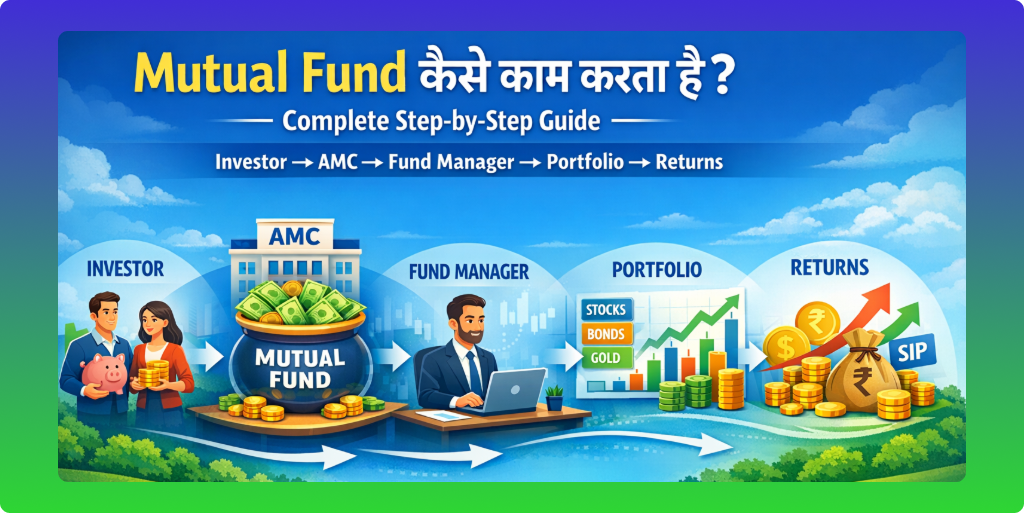
Step 1: Investors Invest Money

Investors choose a mutual fund scheme and invest via SIP or lump sum.

Step 2: Money Is Pooled

Money from all investors is collected into one common fund.

Step 3: Units Are Allotted

Investors receive units based on the NAV of the scheme.

Step 4: Fund Manager Invests

The fund manager invests money as per the scheme objective.

Step 5: Portfolio Grows or Falls

The value of investments changes with market movements.

Step 6: Returns Are Distributed

Profits or losses are reflected in the NAV.

This is the core structure of Mutual Fund कैसे काम करता है.


5. What Is NAV and How It Is Calculated

NAV (Net Asset Value) represents the per-unit price of a mutual fund.

NAV Formula

NAV = (Total Assets – Total Liabilities) / Total Units

NAV changes daily based on market value of investments.

Understanding NAV is essential to fully understand Mutual Fund कैसे काम करता है.


6. Role of Fund Manager in Mutual Funds

The fund manager plays a crucial role.

Responsibilities include:

  • Selecting stocks or bonds
  • Monitoring market trends
  • Managing risk and returns
  • Rebalancing the portfolio

A good fund manager directly impacts how effectively Mutual Fund कैसे काम करता है for investors.


7. How Mutual Funds Generate Returns

Mutual funds generate returns in two main ways.

Capital Appreciation

Increase in value of investments over time.

Income Generation

Dividends or interest earned from securities.

These earnings are reflected in the NAV of the fund.


8. SIP and Lump Sum: Working Mechanism

SIP (Systematic Investment Plan)

Invests a fixed amount at regular intervals.
Reduces market timing risk.

Lump Sum Investment

One-time investment.
Works best when markets are undervalued.

Both methods follow the same underlying principle of Mutual Fund कैसे काम करता है.


9. Where Does Mutual Fund Invest Money

Depending on the scheme type, funds may invest in:

  • Equity shares
  • Government bonds
  • Corporate bonds
  • Money market instruments
  • Index-based securities

Diversification is a key part of how Mutual Fund कैसे काम करता है efficiently.


10. Expenses and Charges in Mutual Funds

Mutual funds charge an expense ratio.

This includes:

  • Fund management fees
  • Administrative costs
  • Marketing expenses

Lower expense ratios generally improve long-term returns.


11. Risks Involved in Mutual Fund Working

Understanding risk is essential when learning Mutual Fund कैसे काम करता है.

Common risks include:

  • Market risk
  • Credit risk
  • Interest rate risk
  • Liquidity risk

Risk varies depending on fund type and investment duration.


12. Mutual Fund Working Example

Example:

  • NAV = ₹20
  • Investment = ₹10,000
  • Units allotted = 500

If NAV rises to ₹25:

  • Investment value = ₹12,500

This simple example explains Mutual Fund कैसे काम करता है in real life.


13. How Investors Make Profit or Loss

Investors earn profits when NAV increases and incur losses when NAV decreases. Selling units at a higher NAV results in gains.

Long-term investing helps smooth short-term volatility.


14. Why Understanding Mutual Fund Working Is Important

Knowing Mutual Fund कैसे काम करता है helps investors:

  • Avoid panic selling
  • Choose the right schemes
  • Plan long-term goals
  • Build disciplined investing habits

Knowledge reduces emotional decision-making.


15. Final Conclusion

Mutual Fund कैसे काम करता है is not complicated once you understand the structure, NAV mechanism, and role of fund managers. Mutual funds provide an organized, regulated, and efficient way to invest money for long-term wealth creation.

With proper understanding, patience, and discipline, mutual funds can become one of the most powerful tools in your financial journey.


Mutual Fund क्या है

Mutual Fund क्या है? – 7 Powerful Reasons Why Smart Investors Choose Mutual Funds in 2026

Introduction

Mutual Fund क्या है — this is one of the most common questions asked by people who want to start investing but are confused about the stock market. In today’s fast-changing financial world, saving money alone is not enough. To beat inflation and build long-term wealth, smart investment planning has become essential.

A mutual fund is considered one of the most popular and beginner-friendly investment options in India. It allows individuals to invest their money in the market without having deep knowledge of stocks, bonds, or financial analysis. Instead of investing alone, your money is combined with other investors’ money and managed by professional fund managers.

Understanding Mutual Fund क्या है is important because it helps you make informed financial decisions. Whether you are a salaried employee, a business owner, or a student planning for the future, mutual funds offer flexibility, diversification, and growth opportunities. With options like SIP, tax-saving funds, and long-term equity schemes, mutual funds have become suitable for almost every type of investor.

In this complete guide, you will learn what a mutual fund is, how it works, its types, benefits, risks, taxation, and how beginners can start investing wisely in mutual funds.

1. What is Mutual Fund? (Mutual Fund क्या है)

Mutual Fund क्या है?
A mutual fund is an investment option where money is collected from many investors and invested in stocks, bonds, or other financial instruments by professional fund managers.

In simple terms, instead of investing alone, investors pool their money together. This pooled money is managed by experts who aim to generate better returns over time.

In India, mutual funds are regulated by SEBI (Securities and Exchange Board of India), which ensures transparency and investor protection.

That is why understanding Mutual Fund क्या है is important for every beginner investor.


2. How Mutual Funds Work

The working of a mutual fund is very straightforward.

  • Investors invest money in a mutual fund scheme
  • The fund manager invests this money in different assets
  • Returns are generated through growth and dividends
  • Profits or losses are shared according to the number of units held

Each investor receives units based on the NAV (Net Asset Value).

Example:
If the NAV of a fund is ₹25 and you invest ₹10,000, you will receive 400 units.

This simple mechanism explains Mutual Fund क्या है in practical terms.


3. Why Mutual Funds Are Popular in India

Mutual funds have become extremely popular in India due to several reasons:

  • Easy online investment process
  • SIP option starting from as low as ₹500
  • Better returns compared to traditional savings
  • Suitable for both beginners and experienced investors

Government awareness campaigns like Mutual Funds Sahi Hai also helped people understand Mutual Fund क्या है and how it helps in wealth creation.


4. Types of Mutual Funds

Understanding different types helps investors choose wisely.

Equity Mutual Funds

These funds invest mainly in shares of companies.
They offer high returns but also carry higher risk.
Best suited for long-term goals.

Debt Mutual Funds

These funds invest in fixed-income securities like bonds.
They offer stable returns with lower risk.

Hybrid Mutual Funds

These funds invest in both equity and debt.
They balance risk and return.

Index Mutual Funds

These funds track market indices such as Nifty 50 or Sensex.
They have a low expense ratio.

ELSS (Tax Saving Mutual Funds)

These funds offer tax benefits under Section 80C.
They have a lock-in period of three years.

These categories explain Mutual Fund क्या है from an investment perspective.


5. Mutual Fund Investment Process

Investing in mutual funds is simple and paperless.

Steps involved:

  1. Complete KYC using PAN and Aadhaar
  2. Choose a suitable mutual fund scheme
  3. Decide between SIP or lump sum investment
  4. Invest through an online platform or mobile app
  5. Track investment performance regularly

Platforms like AMFI, Zerodha Coin, Groww, and Paytm Money are commonly used in India.


6. Benefits of Mutual Funds

Mutual funds offer several advantages.

Professional Management

Fund managers handle investments on behalf of investors.

Diversification

Money is invested in multiple assets, reducing overall risk.

Liquidity

Most mutual funds allow easy redemption.

Affordable Investment

Investors can start with small amounts through SIP.

Transparency

Fund performance, NAV, and holdings are publicly available.

These benefits clearly explain why people want to know Mutual Fund क्या है.


7. Risks Involved in Mutual Funds

Like every investment, mutual funds also involve risks.

Common risks include:

  • Market risk
  • Interest rate risk
  • Credit risk
  • Inflation risk

However, these risks can be managed through long-term investing and diversification.

Understanding risks is an important part of learning Mutual Fund क्या है.


8. Mutual Fund vs Other Investment Options

Investment OptionRisk LevelReturn PotentialLiquidity
Fixed DepositLowLowMedium
GoldMediumMediumHigh
Mutual FundMedium to HighHighHigh
Real EstateHighHighLow

Mutual funds offer a balanced combination of risk and return.


9. SIP vs Lump Sum Investment

SIP (Systematic Investment Plan)

Investment is done regularly every month.
Ideal for salaried individuals.
Reduces market timing risk.

Lump Sum Investment

One-time investment.
Suitable when markets are low.

Both options help investors understand Mutual Fund क्या है practically.


10. How to Choose the Right Mutual Fund

Before investing, consider:

  • Investment goal
  • Time horizon
  • Risk tolerance
  • Fund performance history
  • Expense ratio

Never invest without understanding the fund details.


11. Taxation on Mutual Funds in India

Equity Mutual Funds

Long-term capital gains above ₹1 lakh are taxed at 10 percent.
Short-term gains are taxed at 15 percent.

Debt Mutual Funds

Taxed as per the investor’s income tax slab.

Tax planning is another reason people search Mutual Fund क्या है.


12. Common Myths About Mutual Funds

Many investors believe:

  • Mutual funds are risky gambling
  • Only experts can invest
  • Mutual funds guarantee returns

In reality, mutual funds are regulated and suitable for all types of investors.


13. Is Mutual Fund Safe for Beginners?

Mutual funds are safe if:

  • Investment is done for the long term
  • Right funds are selected
  • Emotional decisions are avoided

Beginners should start with index funds or large-cap mutual funds.


14. Final Verdict

Mutual Fund क्या है?
It is one of the most effective investment options for building long-term wealth in India.

With proper planning and discipline, mutual funds can help investors achieve financial stability and future goals.


Conclusion

Understanding Mutual Fund क्या है is the first step toward smart investing. Mutual funds offer flexibility, diversification, and professional management, making them suitable for beginners and experienced investors alike.